Every market has price levels that become battlegrounds, and for Bitcoin this week that level is $84,000. Only a day ago, Bitcoin’s upside was described as capped beneath the $84,000 supply zone. Now the price has lifted back above $84,000, which analysts read as a solid technical structure despite continued ETF outflows. Whether this is a real breakout or a brief bounce is the question every trader is asking today.
Why $84,000 matters
In technical analysis, a “supply zone” is an area where sellers have repeatedly appeared in the past. When price approaches it, holders who bought higher often sell to break even, which creates resistance. When buyers finally absorb that selling and push above the zone, it can flip into support. That is why a clean move above $84,000 gets so much attention. It suggests demand is strong enough to overpower the sellers who capped the market before.
The level also sits inside a broader trading range. At the start of the month, one market update described Bitcoin as range-bound between $83,500 and $86,600, with key moving averages providing support. The same report noted that the month’s direction would depend on whether Bitcoin breaks out of that range. In other words, $84,000 is not an isolated number. It sits near the middle of a zone the market has been working inside for days.
Recent price action shows how narrow that zone has been. On October 8, Bitcoin’s spot price was listed at $82,446.99 with a 24-hour change of -0.5%. Moving from there to above $84,000 within a few sessions is meaningful, but still modest compared with the large swings crypto is known for.
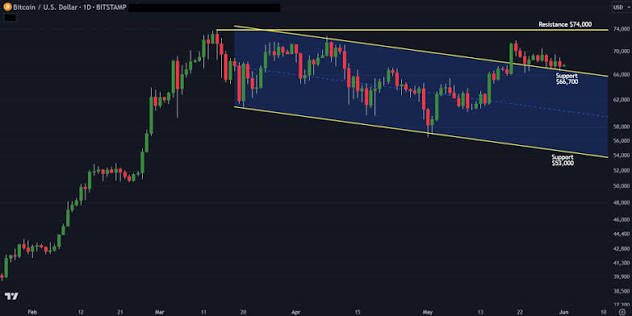
Corporate buyers are still active
Price is only part of the story. Strive added 3,311 BTC to its treasury. Companies that hold Bitcoin on their balance sheets tend to think in years rather than days, so purchases like this add a layer of steady demand that is independent of daily ETF flows. It does not guarantee higher prices, but it helps explain why dips have attracted buyers.
The bigger picture
Bitcoin still dominates the sector. On October 9, CoinGecko put total crypto market capitalization at $2.89 trillion, with Bitcoin holding 57.5% dominance and Ethereum at 10.5%. When more than half the market’s value sits in one asset, Bitcoin’s direction usually sets the tone for everything else.
What could go wrong
The risks are real. ETF outflows reached $681 million last week, and institutions are holding back ahead of the US inflation data due this week. A rally into a major data release can reverse quickly if the numbers disappoint. Traders will also be watching whether Bitcoin can close, not just trade, above $84,000. A brief spike above the line that fades by the end of the day is a much weaker signal than a close above it.
What to watch next
- Whether Bitcoin holds $84,000 on a daily close.
- Whether ETF flows stay positive after the recent swings.
- The reaction to this week’s US CPI and PPI data.
The takeaway: Bitcoin has done the hard part by climbing back above a level that rejected it a day earlier. The next step is proving it can stay there. Until then, this is a cautiously constructive setup, not a confirmed breakout.
Update (October 15): The US CPI report came in hotter than expected and Bitcoin fell back toward the low $81,000s. See our follow-up: “Bitcoin Slips Toward $80,000. Why That Level Matters.”